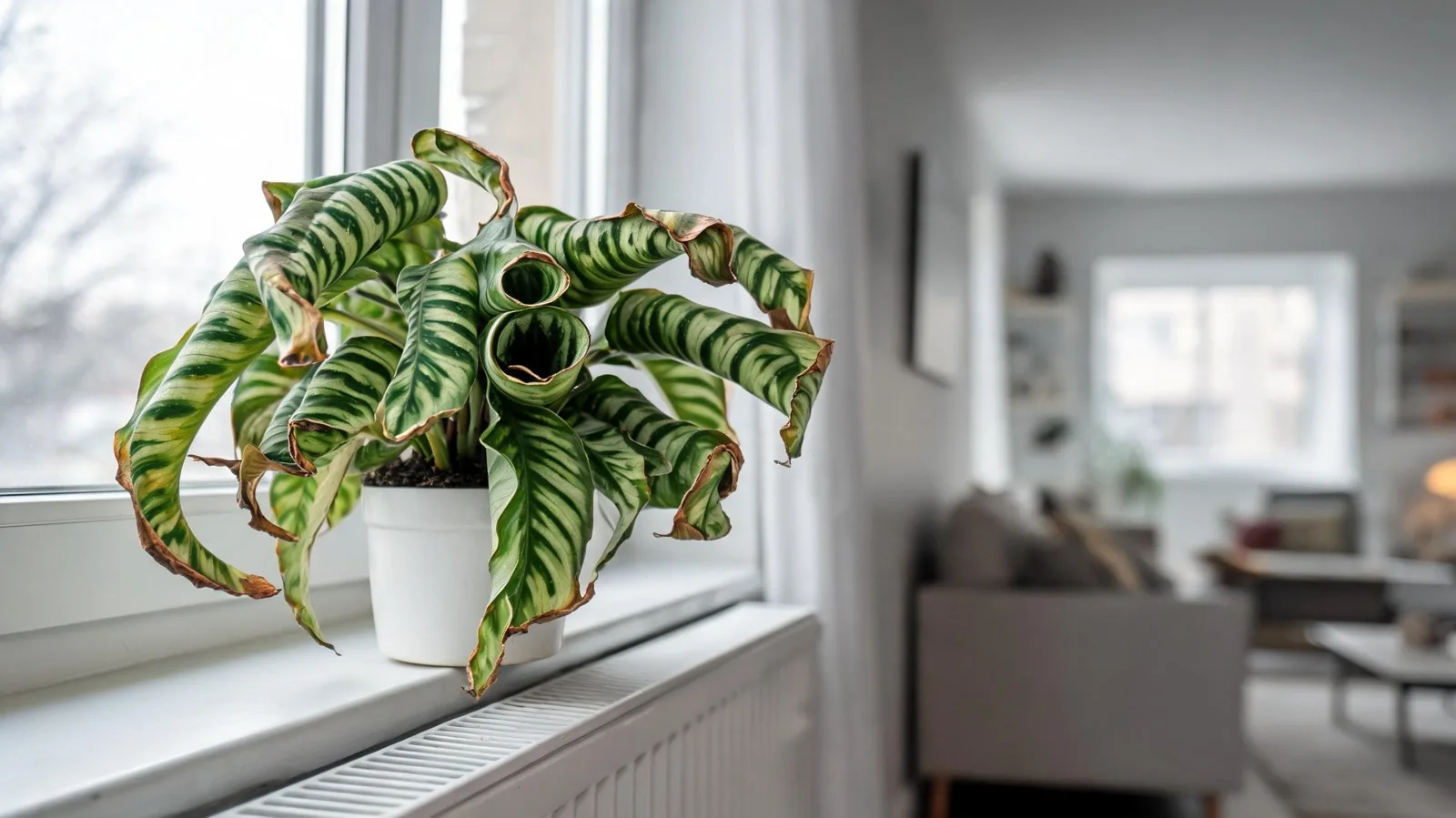
Short answer: calathea leaves curl inward to save water. The usual cause is soil that dried out too far, dry air from central heating, or both. Too much direct sun, cold drafts, spider mites, hard tap water and (less often) soggy soil and root rot can also make the leaves roll up. Crispy brown edges along with the curling point to dry air or minerals in the water. Curling with yellow, drooping leaves and wet soil points to overwatering.
Not sure which one you are dealing with? Upload a photo to our free plant diagnosis tool for a likely cause in seconds, then use the fixes below.
First, is the curling actually a problem?
Calatheas belong to the prayer plant family (Marantaceae). Their leaves move through the day: they lift and partly fold up in the evening and open flat again in the morning. If the leaves are only folded at night, look normal by mid-morning, and have no brown edges or spots, your plant is fine.
It is a problem when the leaves stay rolled into tubes during the day, the edges turn crispy, or new leaves come out already curled. That is the plant reducing the leaf surface to lose less water, and it means something in its care needs to change.
Also check that it really is a calathea. Maranta, stromanthe and ctenanthe look similar and have similar needs. If you are unsure, our plant identifier can tell you from one photo.
Quick diagnosis: symptom → likely cause
| What you see | Most likely cause |
|---|---|
| Leaves rolled inward, soil dry several inches down, pot feels light | Underwatering |
| Curling plus crispy brown leaf edges, plant near a heater or vent | Low humidity (dry indoor air) |
| Curled, faded or bleached leaves on the side facing a sunny window | Too much direct sun |
| Sudden curling and dark, limp patches after a cold night near the window | Cold drafts or cold glass |
| Fine pale speckles, dull leaves, tiny webs under the leaves | Spider mites |
| Brown leaf tips and edges even though watering is right | Minerals in tap water or too much fertilizer |
| Curling with yellowing, drooping stems and soil that stays wet | Overwatering or root rot |
1. Underwatering
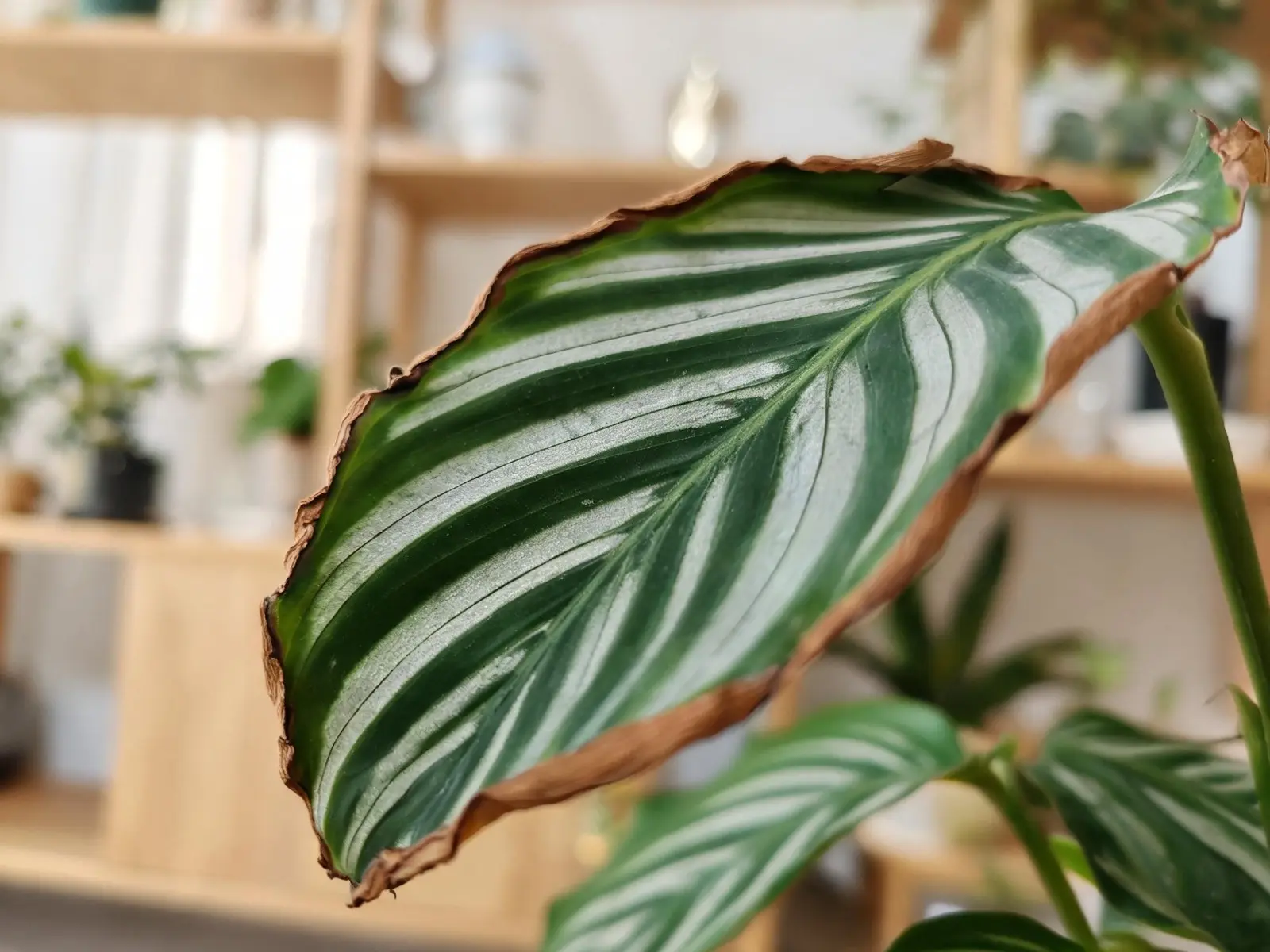
This is the most common reason. Calatheas like soil that stays lightly moist, not bone dry. When the root ball dries out, the leaves roll up within a day or two, and the lower leaves may start to brown. In winter, a plant near a radiator can dry out faster than you expect.
How to fix it
- Push a finger into the soil. If the top 1–2 inches (2–5 cm) are dry, water.
- Water slowly until it runs out of the drainage holes, then empty the saucer after 15–20 minutes.
- If the soil has shrunk away from the pot sides and water runs straight through, bottom-water: stand the pot in a bowl of room-temperature water for 20–30 minutes so the root ball can soak it up.
- Leaves that were only curled usually open again within a day or two. Leaves that turned crispy will not recover, but new growth will be fine.
2. Low humidity from heating
Calatheas come from humid tropical forest floors. In winter, central heating, wood stoves and space heaters can drop indoor humidity well below what they like. The leaves curl and the edges turn brown and papery, often starting on the oldest leaves.
How to fix it
- Move the plant at least 3 feet (about 1 m) away from radiators, heat vents and fireplaces.
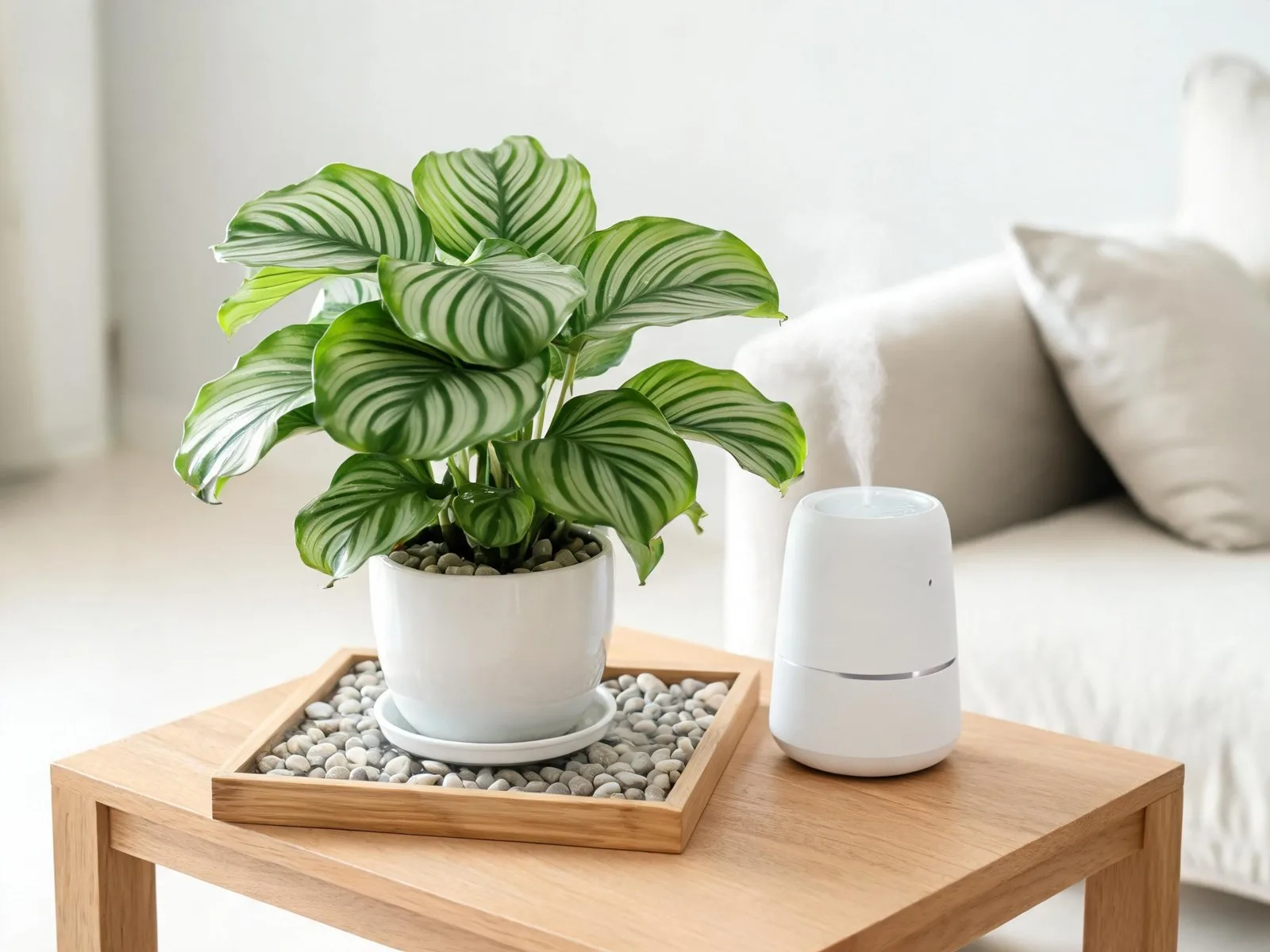
- Run a cool-mist humidifier nearby. Around 50% humidity or higher keeps most calatheas happy. A cheap digital hygrometer shows you the real number.
- Grouping plants or a pebble tray helps a little; misting only lasts a few minutes, so do not rely on it.
3. Too much direct sun
In nature, calatheas grow under taller plants, so strong direct sun is too harsh for them. Leaves curl to protect themselves, colors fade, and patches can scorch brown. A sunny south- or west-facing windowsill is usually too much, even in winter.
How to fix it
- Give bright, indirect light: a few feet back from a bright window, or behind a sheer curtain.
- In a dark room, an LED grow light placed above the plant is fine. Keep it at the distance the manufacturer recommends.
4. Cold drafts and cold windows
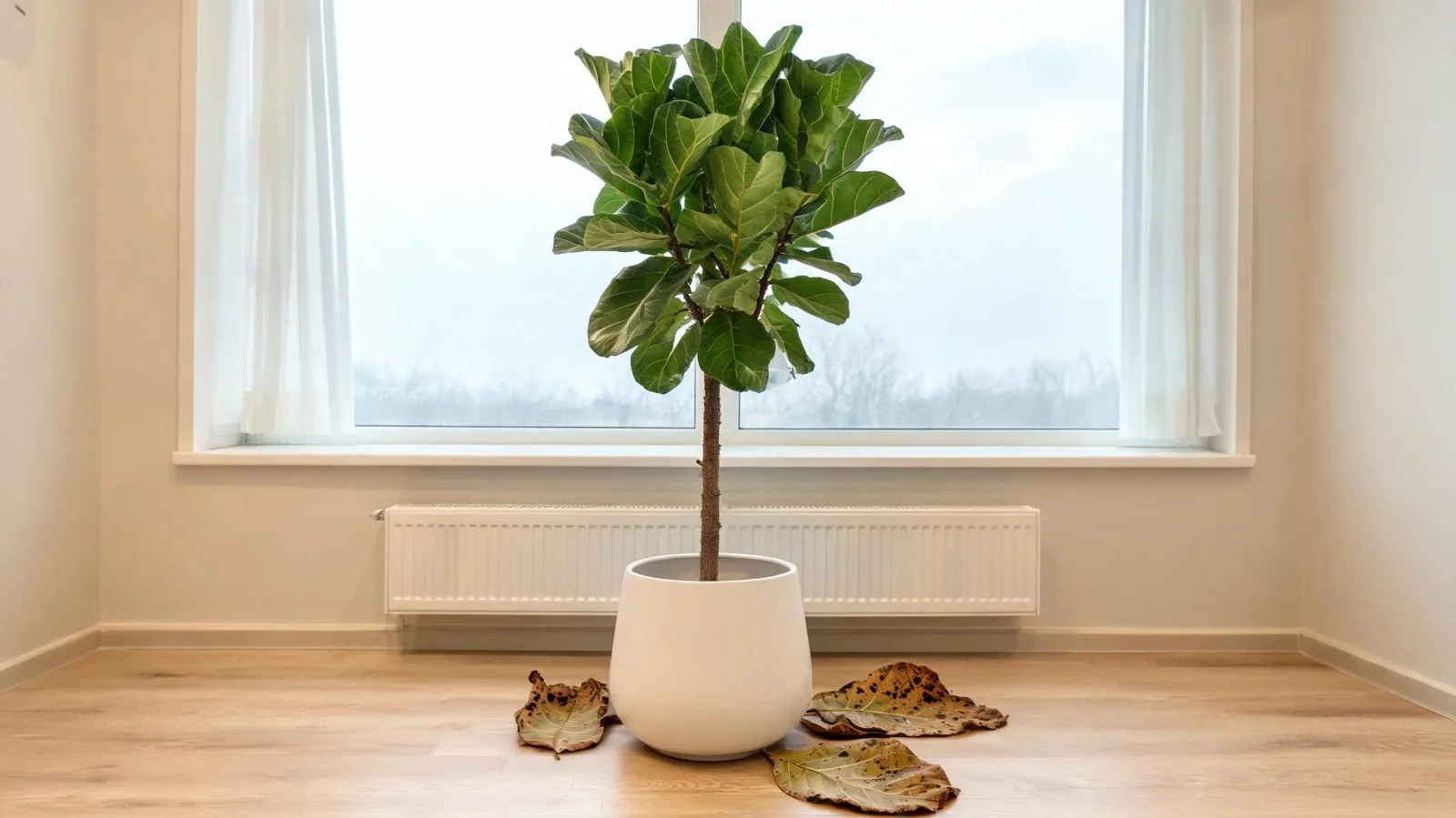
Calatheas are sensitive to cold. Keep them between about 65–80°F (18–27°C) and try not to let them sit below 60°F (15°C). Leaves touching cold window glass, or a spot next to an often-opened door, can cause sudden curling, dark limp patches and drooping. This is very common in November to February, the same reason a fiddle leaf fig drops leaves in winter.
How to fix it
- Pull the plant back so no leaves touch the glass, especially at night.
- Keep it away from entry doors, drafty windows and air-conditioning vents.
- Water with room-temperature water, not cold water straight from the tap.
- Cut off leaves that have gone black or mushy; healthy leaves will recover once the plant is warm.
5. Spider mites
Dry, warm indoor air is ideal for spider mites. They feed on the undersides of leaves, leaving tiny pale speckles. Leaves look dull or dusty, then curl and dry out. In heavier infestations you see fine webbing where the leaf meets the stem.
How to fix it
- Check by wiping the underside of a leaf with a white tissue. Tiny moving dots or reddish-brown streaks confirm mites.
- Rinse the leaves, especially the undersides, in the shower with lukewarm water.
- Wipe or spray every leaf with insecticidal soap or diluted neem oil, following the label. Repeat every 5–7 days for 3–4 weeks, because new mites keep hatching.
- Raise the humidity (see cause 2). Mites hate humid air.
6. Hard tap water, salts and too much fertilizer
Calatheas are known to be sensitive to minerals and salts. Water high in fluoride or dissolved salts, or too much fertilizer, builds up in the soil and shows as brown tips and edges, often with some curling. A white crust on the soil surface or pot rim is a common clue.
How to fix it
- Switch to distilled, filtered or rainwater if your tap water is hard.
- Flush the soil every few months: run plenty of water through the pot and let it drain fully.
- Feed only in spring and summer, with a balanced liquid houseplant fertilizer at half the label strength. Skip feeding in winter when growth slows.
- Do not confuse a white crust with fuzzy white mold; if it looks cottony, see how to remove white fungus from plant soil.
7. Overwatering and root rot
It seems backwards, but soggy soil can also cause curling. Roots that sit in water lose oxygen and start to rot, so they cannot take up water and the leaves curl and droop as if the plant were dry. Usually you also see yellowing leaves, mushy stems at the base and soil that smells sour. This is most likely in winter, when the plant uses less water. Our guide to yellow leaves on indoor plants covers this pattern in more detail.
How to fix it
- Stop watering and let the top 1–2 inches (2–5 cm) dry before the next drink.
- Make sure the pot has drainage holes and never leave it standing in a full saucer or a decorative pot without drainage.
- If the plant keeps getting worse, check the roots (see below).
Step-by-step: how to get a curling calathea back on track
- Check the soil. Dry deep down? Water thoroughly. Wet and heavy? Hold off and look at the roots if the plant is declining.
- Check the location. Move it out of direct sun, away from heaters, vents, doors and cold glass.
- Raise the humidity. Run a humidifier or group it with other plants.
- Check for pests. Look under the leaves with a flashlight and do the tissue test.
- Change the water. Use filtered, distilled or rainwater at room temperature.
- Trim the damage. Snip off crispy edges with clean scissors, following the leaf shape, or remove leaves that are mostly brown at the base of the stem.
- Be patient. Give it 2–4 weeks in a stable spot and judge progress by the new leaves.
When to repot, and when it can't be saved
Unpot the plant if it keeps declining with wet soil, the base feels soft, or the soil smells bad. Healthy roots are firm and white to light tan. Rotten roots are brown or black, mushy and may slide apart when you touch them.
- Trim all rotten roots with clean scissors.
- Repot into fresh, airy potting mix (standard houseplant mix with some perlite or orchid bark works well) in a pot only slightly larger than the root ball, with drainage holes.
- Water lightly and keep it warm and out of direct sun while it recovers.
If most of the roots are mushy and the stems have collapsed at the soil line, the plant is unlikely to recover. Calatheas grow from underground rhizomes, so if any firm section with healthy roots and a few leaves remains, you can pot that piece up on its own. For a plant in serious trouble, follow our emergency steps to save a dying plant.
Calatheas are listed by the ASPCA as non-toxic to cats and dogs, so a curious pet nibbling a leaf is not a poisoning worry. Keep sprays like neem oil and insecticidal soap away from pets until the leaves are dry.
Check your plant's problem from a photo
If the leaves still curl after these changes, there may be more than one cause at once, such as dry air plus mites. Take a clear photo of the whole plant and one of a damaged leaf, then upload it to the free Plant Solutions diagnosis tool to narrow it down.
Frequently asked questions
Will curled calathea leaves uncurl?
Yes, if the leaf is still green and soft. Once the cause is fixed (usually watering or humidity), curled leaves often open again within a few days. Leaves that are crispy or brown will not recover, but new leaves will come out flat.
Why do my calathea leaves curl at night?
That is normal. Calatheas are prayer plants, and their leaves fold up in the evening and open in the morning. It is only a problem if they stay curled during the day.
How often should I water a calathea in winter?
There is no fixed schedule. Water when the top 1–2 inches (2–5 cm) of soil are dry. In a cool room that may be every 1–2 weeks; near a heater it may need more often. Always check the soil first.
Can I use tap water for my calathea?
Many people do without problems, but if you see brown tips and edges, switch to distilled, filtered or rainwater. Calatheas are more sensitive to minerals and fluoride than most houseplants.
Should I cut off curled or brown calathea leaves?
Cut off leaves that are mostly brown or dead at the base of their stem. You can trim just the crispy edges on otherwise healthy leaves. Leave curled green leaves alone; they still feed the plant and may open again.